Wednesday, 12 June 2013

Intoxication 2013 Paris


We are very pleased to announce the final schedule, and the opening of registration for this year’s conference.
We are also particularly pleased to announce the two keynote speakers for the day: cultural historian and author Mike Jay and Dr Benjamin Noys from the University of Chichester. For more details about our keynote speakers, please click here.

Those wishing to attend are invited to register by contacting Eugene.brennan@ulip.lon.ac.uk.

Intoxication in Paris, June 28th 2013.
Granville Barker room, 4th floor, University of London Institute in Paris, 9-11 rue de Constantine, 7th arrondissement, Paris (Métro: Invalides).
0
9h30 – 9h55 : Registration
9h55 : Opening remarks
10h05 – 11h00, Panel one: Intoxication in the Nineteenth-Century
Dr Susannah Wilson (University of Warwick), ‘Women and Drugs in late Nineteenth-Century France’.
Keynote address: Mike Jay (author and cultural historian), ‘The Green Jam of « Doctor X »: Science and Literature at the Club des Hachichins’.

11h15 – 11h30 : Coffee break

11h30 – 12h45, Panel two : Poetic Intoxications
Eugene Brennan (University of London Institute in Paris), ‘Apophatic theology and the poetics of the sacred: intoxication in the (anti-)poetry of Georges Bataille.’
Mathieu Perrot (Université Paris Ouest Nanterre La Défense), ‘Riding the lines: The images of the “chevauchements” in Henri Michaux’s poetics and drug experiments’.
Alessandro Cabiati (University of Edinburgh), ‘An ecstatic journey towards the unknown: Arthur Rimbaud, Jim Morrison and the art of intoxication’.

12h45 – 14h00 : Lunch break

14h00 – 15h30, Panel three : Dipsomaniacal novel(ist)s
Dr Joe Kennedy (University of Chichester), ‘Tipsiness and « The Reigning Stupefaction » in British Fiction of the late 1940s’.
Hemlata Giri (Université Paris III Sorbonne Nouvelle/University of Delhi), ‘A toast to solitude. The theme of alcohol in the works of Michel Houellebecq’.
Anne-Lucille Gérardot (Université de Reims Champagne-Ardennes, CRIMEL), ‘Boire Dit-Elle : Un Tour Du Monde De L’Alcool Durassien’,

15h30 – 15h45 : Coffee break

15h45 – 17h00, Panel four : Biopolitical Intoxications
Joshua Rivas (Princeton University), ‘Intoxication and toxicity in a « pharmacopornographic era » : Beatriz Preciado’s Testo Junkie’.
Christopher Collier (University of Essex) and Joanna Figiel (City University London), ‘The Recombinant Dérive – The Situationist International, biopolitics and the neoliberal dérèglement de tous les sens’.

17h00 – 18h00, Panel five : Critiques of Intoxication in Theory and Politics
Alastair Hemmens (University of London Institute in Paris), “Beau comme le tremblement des mains dans l’alcoolisme”: A Cavalier History of Drugs and Intoxication in the Situationist International.
Keynote address: Dr Benjamin Noys (University of Chichester), ‘Intoxication and Acceleration’

18h00 – 18h05 : Break

18h05 – 19h00, Panel six : Paris, Capital of Intoxication
Simone Paterman (Université Paris VIII), ‘L’abstinence créatrice. Les errances de Jack Kerouac et d’Henry Miller à Paris’.
Adam Biles (writer, author of Grey Cats, 3AM Press, 2012), ‘Night Tremors: Stories From Nocturnal Paris.’

19h00 + : Drinks (TBC)

Tuesday, 14 May 2013

Negativity, Communization, and the End(s) of Art (Stockhom)

INSTITUTE FOR COLLECTIVE STUDIES
Open house 17 may from 19.00
Guest: Benjamin Noys
Negativity, Communization, and the End(s) of Art

 
www.weld.se

OSA at info@weld.se (Reading list to be sent by request)

Between 14-17 May Institute for Collective Studies moves in at Weld for a kind of site-specific reflection on the subject Collectivity and the Negative. ICS examines practical strategies for how one can be active without producing added value. On Friday at 19h we invite you to an open house event along with Benjamin Noys.
Welcome!
Participants:
Corina Oprea, Johanna Gustavsson, Cecilia Germain, Rasmus Nielsen och Anders Paulin.

Institute for Collective Studies
is a reply to the increased profile on instrumentalization of artistic research in both an academic and professional context.


In this context of the institutionalization and commodification of artist practice as well as knowledge, Institute for Collective Studies intends to investigate different formats of independent research structures, allowing questions and activities in a collective context.


Parallel to the growing production of artistic research and criticality, discourse and reflection do risk to become consumer products rather than implemented tools. In the hectic up-beat techno tempo of innovation ideology, programmers of art venues as well as research departments easily turn into fashionistas anxiously looking for the next discoursive Harlem Shake, scared stiff that they might not discover it until it already has become last years Gangnam Style.


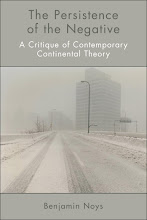
Benjamin Noys is Reader in English at the University of Chichester. He is the author of Georges Bataille: A Critical Introduction (2000), The Culture of Death (2005), The Persistence of the Negative: A Critique of Contemporary Theory (2010), and editor of Communization and Its Discontents(2011).


ICS is initiated by Corina Oprea and Anders Paulin.

Weld Norrtullsgatan 7 SE -113 29 Stockholm +46 8 30 94 50 info@weld.se www.weld.se

Thursday, 25 April 2013

Brute Symposium, Centre for Creative Collaboration London (3 May 2013)


TRANSMISSION


­BRUTE [Test 1] 


Symposium


Michelle Atherton and Becky Shaw


Peter Adey, Dales Holmes, Esther Leslie, Benjamin Noys


Friday 3rd May 2013

2.00 to 6.30 p.m.


Centre for Creative Collaboration

16 Acton Street London Greater London WC1X 9NG


Test No. 1 takes the notion of BRUTE as a raw starting point, an approach to collaboration.  We will explore the problem of an intellectually ‘cold’ position’, alongside ideas of force including heat, abrasion, friction, and compression. We want to address how the time and processes of force might relate to the allegedly more timeless and dematerialised nature of thought, to consider the conditions of force as applied to materials and upon the material of society. We are interested in banging some disparate things together: ‘Waking and burning, shocking and blasting’, as Rachel Moore describes Hollis Frampton’s work Nostalgia.  We are trying to create an experience that does not demand participation nor assumes affect, but tries out the idea of a BRUTE methodology.
 

This event is free, but places are limited to thirty participants.

 
Deadline for booking is 29th April.


To register, please email m.atherton@shu.ac.uk

PROGRAMME


 14.00                         Registration, with accompanying soundtrack by Dale Holmes


14.30                         Introduction – Michelle Atherton and Becky Shaw


15.00                        Peter Adey – 'Combustion':  pandemonium, air, industry, and social change, as carbon turns to air, mixing with revolutionary fervour; war, blast, and vaporisation, as bodies occupy the air, with ecstatic levitators burning.


15.30                        Benjamin Noys –  ‘Derailing the Train: Brutal Accelerations & Brutal Interruptions’


16.00                        Esther Leslie – a text drawn from her book Synthetic Worlds examining the violence of extraction, in the light of the German chemical industry’s use of coal for synthetic colour


16.30                         Tea/coffee


17.00–18.00                Plenary  


18.00                          Wine


Peter Adey is Reader in Human Geography at Royal Holloway, University of London. He works at the intersections of space, security, and mobility. He is author of Mobility (2009); Aerial Life: spaces, mobilities,
 affects
(2010), and Air (forthcoming). He was the recipient of a Philip Leverhulme Prize in 2011.


Michelle Atherton is an artist interested in objectifying cultural phenomenon, often using transport systems as a starting point.  Recent works include Dreams of Flying and Missed the Boat I & II, exhibited widely in Europe.  Her research is supported by the AHRC. She is a senior lecturer in Fine Art at Sheffield Hallam University.


Dale Holmes is an artist and AHRC-funded PhD candidate in the Art and Design Research Centre at Sheffield Hallam University. His current research develops a material philosophy grounded on non-anthropocentric strategies for making and staging art works. His work has been exhibited internationally.


Esther Leslie is Professor in Political Aesthetics, Birkbeck, University of London.  Recent publications include Hollywood Flatlands: Animation, Critical Theory and the Avant-garde (2002), Synthetic Worlds: Nature, Art and the Chemical Industry (2005), Walter Benjamin: Critical Lives (2007).  She sits on the editorial boards of Historical Materialism, Revolutionary History, and Radical Philosophy.


Benjamin Noys is Reader in English at the University of Chichester. He is the author of Georges Bataille: A Critical Introduction (2000), The Culture of Death (2005), The Persistence of the Negative: A Critique of Contemporary Theory (2010), and editor of Communization and Its Discontents (2011).


Becky Shaw explores the relation between objects and people, and ideas of objectivity and subjectivity.  Recent works include 20 Euros, a work made for Terminal Convention at Cork Airport, and A: The Christmas Party a durational reading performed at Roehampton University, Terry O’Connor.  She is Course Leader of the B.A. Creative Art Practice course at Sheffield Hallam University.


This event is part of Transmission, a project convened by Dr Jaspar Joseph-Lester and Dr Sharon Kivland, with the support of the ADRC (Art and Design Research Centre), Sheffield Hallam University, and HARC (Humanities and Arts Research Centre), Royal Holloway University of London. Transmission is an arena in which ideas of art practice are discussed and tested through an annual publication, a lecture series, and related research events in Sheffield, London, Dallas, and Berlin. http://www.transmission.uk.com


The Centre for Creative Collaboration (C4CC) is an initiative of the University of London, working in collaboration with the Royal Central School of Speech and Drama, Goldsmiths, University of London, and Royal Holloway, University of London.  C4CC supports new types of collaboration using the principles of open innovation, hosting projects and enabling multi-disciplinary working in an attractive and flexible space.  C4CC brings together leading and innovative researchers from London’s universities and colleges, creative industry practitioners and freelancers, SMEs, and students.   http://www.creative-collaboration.net


Thursday, 14 March 2013

Broken Performances: Time and (In)Completion (Zagreb)

I will be speaking at this event in Zagreb. Here's the programme:


Program:
21.03.2013
18.00 @ Pogon Jedinstvo Bojan Djordjev: What I have Learned about Capitalism – (never ending self) lecture performance
20.00 @ Pogon Jedinstvo BADco.: Is There Life On Stage? – performance

22. 03.2013
11.00 @ mama The research group of Maska’s Seminar for Contemporary Performing Arts: Broken Lecture
12.45 @ mama Nik Wakefield: A Genealogy of Performance Itself: Bergsonian Memory and Documentation
13.15 @ mama Tomislav Medak: Theatre and Totality
17.00 @ mama Sean Cubitt: Visible time -keynote
18.00 @ mama Marie-Luise Angerer: Too Much Time – keynote
19.30 @ mama Bojana Cvejić, Marta Popivoda and Ana Vujanović (TkH – Walking Theory, Belgrade): Public Sphere by Performance and Yugoslavia, how ideology moved our collective body – book and film presentation

23. 03.2013
11.00 @ mama Karin Harrasser: “There, everybody who stutters, is obliged to limp”. Time-Images in Heiner Göbbels, Alexander Kluge, Samuel Beckett
11.30 @ mama Goran Sergej Pristaš: The Time After (In)Completion
13.00 @ ZPC Marjana Krajač: Manual For Empty Spaces – entering the performance – performance
17.00 @ mama Benjamin Noys: The War of Time: Occupation, Resistance, Communization -keynote
18.00 @ mama Stephen Zepke: Art, Communization and the Biopolitical Event – keynote
19.00 @ Gallery Nova Franck Leibovici: Formes des vie – book presentation
20.00 @ Theatre &TD Saška Rakef: The Debt of Rakef Saška – performance

24. 03.2013
21.00 @ Cinema Tuškanac Nicolas Rey: Differently, Molussia – film screening
This symposium and its topic are a continuation of BADco.’s artistic interest to relate performance and time. More concretely, it was motivated by BADco.’s work on the development of imaging technologies and their application in performative settings, and it revolves around inquiry of images and performances of time in the technologically driven production – both in the capitalist economic production, in the work with technologies on-stage and in the work of dance as an old technology.
The symposium is a part of our participation in the project “TIMeSCAPES – Images and performance of time in late capitalism.” TIMeSCAPES is a long-term artistic research and production platform initiated by five cultural organizations: BADco. (HR), Maska (SI), Walking Theory (RS), Science Communications Research (A) and Film-protufilm (HR). It brings together four organizations, whose internationally renowned artistic and cultural practice is rooted in research, publishing and discourse, with one science-oriented organization developing methodologies of artistic research. The double objective is to research and artistically reflect the transversal issue of time that cuts across economy, society and art: structure of working time in different economic contexts, temporal experience in technologies, performative dramaturgies of time, etc.; while at the same time tackling the issue that has acute resonance in cultural and academic contexts across Europe: what should the models and institutions of artistic research be, given the constraints of time, money and mobility that artists face.

The attendant artistic program is organized in collaboration with the Multimedia Institute/MAMA, Academy of Drama Arts – University of Zagreb, POGON – Zagreb Centre for Independent Culture and Youth, Culture of Change – Student Center, What, How and for Whom/WHW, Zagreb Dance Center and Institut français de Zagreb.

Concept, organization and coordination: Goran Sergej Pristaš, Jasna Žmak & Tomislav Medak
Production: Lovro Rumiha

“Broken Performances: Time and (In)Completion” is part of TIMeSCAPES, Images and performances of time in late capitalism, a partner project of BADco. (Zagreb), Maska (Ljubljana), Science Communications Research (Vienna), Walking Theory (Belgrade), Film-protufilm (Zagreb) and Academy Of Dramatic Arts, University of Zagreb. With the support of the Culture Programme of the European Union.
The symposium and artistic programme are supported by the Ministry of Culture of the Republic of Croatia and Office for Education, Culture and Sport of the City of Zagreb.

Thursday, 7 March 2013

Accelerationism in Lisbon

I'm doing two events in Lisbon, one which is based around 'The Grammar of Neoliberalism' and the second around 'Cyberpunk Phuturism' (this will also form a chapter in the new book on accelerationism.


Monday 11 March
'The Grammar of Neoliberalism: A Discussion', Unipop, @ RDA69.


Tuesday 12 March


10 am 'Cyperpunk Phuturism', 'Movement & Technical Mobilization' Conference

The Weird: Fugutive Fictions/Hybrid Genre CFP


The Weird: Fugitive Fictions/Hybrid Genre
A one day research conference in association with the Centre for Contemporary Literature, Birkbeck, exploring the weird literary tradition and the many facets of weird writing.

Keynotes: S.T. Joshi / Professor Roger Luckhurst / more TBA

Friday 8th November 2013 / Senate House, London

Until recently weird fiction, if acknowledged at all, was usually considered to be a marginal mode in the already lowly Gothic tradition - less a genre than a particular affect. In the last ten years, however, it has come to be regarded as a separate and distinct form with an increasingly important role to play in the theory of popular genre. The debate has broadened its scope to perceive and explore connections with discourses, literary traditions and cultures not previously associated with the Weird. This call for papers invites contributions that engage with weird fiction in its various aspects, including, but not limited to, the following topics and authors:


• The weird cosmic horror tradition of H.P. Lovecraft and his ‘Weird Tales’ contemporaries

• The recent New Weird advocated by China Miéville and others

• The evolution of the Weird

• The global Weird - weird fiction in translation

• Genre theory and fugitive forms

• Modernism and the Weird

• Weird Philosophy and Weird Theory


Please send 250 word abstracts for 20 minute papers, together with a brief biography, to theweirdconference@gmail.com by 1st August 2013.

Thursday 7th November 2013 (evening event): weird fiction reading (details TBC)

Follow ‘The Weird’ on Twitter: @WeirdConference

This conference is supported by the Birkbeck Centre for Contemporary Literature, Birkbeck School of Arts, and the Institute of English Studies, University of London.

Wednesday, 13 June 2012

2nd Brighton-Sussex Postgraduate Colloquium Day in Critical Thought

2nd Brighton-Sussex Postgraduate Colloquium Day in Critical Thought


hosted by the Centre for Social and Political Thought, University of Sussex, and the Critical Studies Research Group, University of Brighton

June 21st, 2012
10.30 – 11.30 Panel 1:
Ian Sinclair (Brighton): ‘Reading Rancière’
Toby Lovat (Brighton): ‘Meillassoux on contingency and the absolute’

11.30 – 13.00 Panel 2:
Tim Carter (Sussex): ‘Love and its objects: Thoughts on a passage from Adorno’
Birgit Hofstaetter (Brighton): ‘Thinking with the movement of language: Adorno on music and philosophy’
Aidan Simpson (Sussex): ‘Ernst Bloch, utopia and activism’

13.00 -14.00 Lunch

14.00 – 15.30 Panel 3:
Jaakko Immonen (Brighton): ‘Merleau-Ponty and Adorno as materialist thinkers’
Alex Elliott (Sussex): ‘Punching Adorno in the face, epistemologically: Possible problems with physical experience in Negative Dialectics’
Dimitri Kladiskakis (Sussex): ‘Social origins and subjectivity: a critique of the state of nature’

16.00 – 17.00 Keynote:
Gordon Finlayson (Sussex): ‘30 years on: Habermas’s Critical Theory and the Problem of Normative Grounds’

All talks will take place in Fulton 203, University of Sussex

Sunday, 4 March 2012

Postautonomia


The University of North Carolina at Chapel Hill, May 3-5, 2012

@ The Institute for the Arts and Humanities/Global Education Center in collaboration with the University of Michigan, Ann Arbor and NWO

The conference The Anomie of the Earth is a follow-up to the Post/autonomy conference held in Amsterdam in May 2011.

While the Post/autonomy meeting focused on the European dissemination of autonomist thought, the second conference will build on its American location and explore a plurality of notions and practices of cultural-political autonomy. Though privileging the context of North and South America, the conference will also address European, African and Asian perspectives.

A presupposition of the conference is that what Carl Schmitt has defined as the Western “nomos of the Earth” – i.e. the political, legal, and spatial configuration of a Euro-Atlantic modern global order – is currently being shaken by intense endogenous and exogenous forces. By discussing the potentials and limits of autonomy/autonomia within our actual conjuncture, the conference will address the emerging nomos and its new constellations of life and knowledge.

More specifically, the conference will thematize the intersections of autonomy/autonomia with four lines of research that have reframed current debates in the humanities and social sciences:

* radical conceptualizations of life, labor, sovereignty, borders, precarity, migrations, communities and commons, multitude;
* spatial, affective, ethical and ecological forms of resistance to neoliberal capitalism;
* critical trends taking place at the edges of contemporary epistemologies; such as vitalisms, geo-philosophies, biopolitics, political anthropologies, new materialisms, political ontologies and ecologies, subaltern studies, embodiment and emergence theories;
* decolonial studies and new theorizations of post-capitalist, non-liberal and non-statist modes of knowledge and political practice; decolonial feminisms.

These broad themes should be focalized through a specific engagement with autonomy/autonomia.

We welcome the submission of papers in English. Accepted papers will be posted online on the conference website. For the panels, speakers will be asked to make short (10-15 minutes) presentations addressing the main topics of their papers.

Please send your paper, together with a short abstract, by March 1 to the.anomie.of.the.earth@gmail.com. Given the limited size of the conference, only a small number of papers will be accepted. Conference organizers will send acceptance notifications by March 21.

For further information, please contact the.anomie.of.the.earth@gmail.com

This conference is the second of a series within the project Precarity and Post-autonomia: the Global Heritage funded by NWO (Dutch Organisation for Scientific Research).

Confirmed participants
Giuseppe Bianco (University of Warwick/CIEPFC)
Jodi A. Byrd (University of Illinois)
Gustavo Esteva (Universidad de la Tierra)
Silvia Federici (Hofstra University)
Michael Hardt (Duke University)
Timothy S. Murphy (University of Oklahoma)
Benjamin Noys (University of Chichester)
Catherine Walsh (Universidad Simon Bolivar)
Gareth Williams (University of Michigan, Ann Arbor)

and the planning committee:
Federico Luisetti, John Pickles, Wilson Kaiser (University of North Carolina, Chapel Hill),Vincenzo Binetti (University of Michigan, Ann Arbor)

in collaboration with, at the University of North Carolina, Chapel Hill: Samuel Amago, Yusuf Al-Bulushi, Emilio del Valle Escalante, Arturo Escobar, Diana Marcela Gomez Correal, Lawrence Grossberg, Michal Osterweil, Michael Palm, Alvaro Reyes
and the NWO partners: Frans-Willem Korsten (Leiden University/Erasmus University Rotterdam), Joost de Bloois (University of Amsterdam), Silvia Contarini (Université Paris Ouest, Nanterre La Défense), Monica Jansen (Utrecht University)

Sponsors
NWO, Department of Romance Languages and Literatures (University of Michigan, Ann Arbor), and the Center for Global Initiatives, College of Arts & Sciences, Department of Romance Languages and Literatures, Center for European Studies, The Institute for the Arts and Humanities, The Institute for the Study of the Americas, Department of Geography, Program in Comparative Literature, Department of Anthropology, Department of Communication Studies, Cultural Studies@UNC (UNC-Chapel Hill), Department of Romance Studies (Duke University)


Tuesday, 17 January 2012

The Great University Gamble event


The Theory Research Group presents
Andrew McGettigan, ‘The Great University Gamble: money, markets and the future of HE’
Thursday 2 February, 5-7pm, University of Chichester, Cloisters.


Dr Andrew McGettigan is a freelance writer, speaker and researcher based in London. He writes on philosophy, the arts and education. He blogs at Critical Education, and has been a key figure in the analysis and critique of the current government's changes to the system of Higher Education in the UK (see paper here). He is currently writing a book for Pluto press on this subject.

For further details of the event please contact Dr Benjamin Noys, Reader in English, The University of Chichester.

Friday, 28 October 2011

Plastic Materialities


A Workshop with Catherine Malabou


Supported by the National Science Foundation, USA, and


University of London, Queen Mary


All events held at Goodenough College,


Mecklenburgh Square, London WC1N 2AB
 
Friday 4 November

Small Common Room, Goodenough College

9:45 Coffee/tea

10:00 Introduction

10: 15 PANEL 1—Chair, Jonathan Goldberg-Hiller
Insects, War, Life
Renisa Mawani, Associate Professor of Sociology, University of British Columbia
In this paper, I consider how contemporary terrains of war and intensifying regimes of global violence have been mobilized and have gained traction through the deployment of nonhuman animals, most notably insects. Drawing from recent approaches in the “new materialisms” and from the work of vitalists, including Henri Bergson, I argue that prevailing conceptions of “life” and the “living” in debates over the biopolitical that remain tightly tethered to human life must be expanded to encompass nonhuman life forms. An interspecies approach to life is critical, I argue, not only to grasp how current tactics of war have evolved and expanded, but also as a way of generating new possibilities for political praxis. I conclude the paper with a discussion of plasticity as refusal and creativity

The Crumpled Handkerchief
Jane Bennett, Professor of Political Science, Johns Hopkins University with
Bill Connolly, Professor of Political Science, Johns Hopkins University
Today a significant minority of political theorists, philosophers, anthropologists, and historiographers affirm a cosmology of "becoming." Drawing variously upon Nietzsche, Bergson, Whitehead, Deleuze and Guattari, Serres, and others, they define the cosmos as an interacting set of temporal systems punctuated by an ontological ruckus. This cosmos goes through periods of creative flow or generative process. Such references sometimes give short shrift to the tendency of specific things and relations to congeal, persist and even perdure against disruptive pressures, particularly when political life is discussed. In this essay, we acknowledge the uncanny fact that individuated entities emerge, collaborate, and manage to withstand the hustle and flow of a world of becoming. How do shapes manage to distinguish themselves from the onto-field? What initiates congealing into objects? Once a congealing occurs, what kinds of pressures help to destabilize it? The goal is to attend both to the fragile, contingent quality of any process of self-ordering and to the strange systematicity proper to a mobile and protean world. We use Serres's figures of ontological" noise" and "crumpled" time and Deleuze's notion of the "powers of the false" to 1) reflect critically upon the tendency to privilege process over product within ontologies of becoming and 2) begin to refine our understanding of the complex oscillations between becoming and persistence. At the end of the essay, we draw out some implications of these notions for the practice of historical analysis.

12:15 Tea and Coffee


12: 30 PANEL 2—Chair, Silvana Carotenuto
Zones of Justice: A Philo-Poetic Engagement
Michael J. Shapiro, Professor of Political Science, University of Hawai‘i
In this essay I stage an encounter (a “philo-poesis”) between philosophical and literary enactments of the concept of plasticity, which I apply to a reading of Mathias Énard’s novel Zone (2010). After explicating three approaches to plasticity, those of Catherine Malabou, M. M. Bakhtin and Walter Benjamin, I offer a political reading of the novel, focusing on what I refer to as a “justice dispositif,” which surrounds the experience of the novel’s protagonist, a French Croatian, Francis Servain Mirković, who had enlisted to fight in the ethnic purification-driven Croatian independence war and had reformed. As the novel opens, he has collected an archive of the atrocities in the Mediterranean zone and is bringing them to Rome to sell to the Vatican archives. In addition to mapping the justice dispositif that frames the trajectory of Mirković’s experiences, I suggest a politics of archives that would allow them, in Jacques Derrida’s terms, to “open out [to the] future,” i.e., to be rendered as “plastic” and thus be unsealed and open to ongoing critical commentary.

2: 30 PANEL 3—Chair, Fred Moten
Plasticity and the Cerebral Unconscious: New Wounds, New Violences, New Politics
Catherine Kellogg, Associate Professor, Department of Political Science, University of Alberta, Edmonton
My interest in in this paper lies in tying Catherine Malabou’s later work on the neuronal, plastic subject to her first book, The Future of Hegel. Specifically, I ask how the contemporary mode subjective anticipation she suggests might form ‘us’ articulates with the new violence she describes in her book, The New Wounded. In the Hegel book, she says that in the current moment we live under the shadow of the contradictions of “saturation and vacancy”, in which there is no event that is not a world event (saturation) and yet we are left with the sense that it seems there is “nothing left to do” (vacancy). Indicating that this unity of saturation and vacancy gives rise to a new perspective wherein life itself can no longer be thought in terms of an opposition between the natural and the artificial, but rather in terms of an automatism circulating in each and every life, that may be at once “self-engendering and self-destructive,” she says that we are invited into “the serenity and peril of the Sunday of life” (193). In her new book, Les Nouveaux blesses, she comes back to this saturation and vacancy on new terrain. Naming as the ‘new wounded’ those who have lived through the violent effects of war, earthquakes, tsunamis or sexual and/or domestic trauma on the one hand, and those who have had their personhood destroyed by brain traumas such as Alzheimer’s or Parkinson’s disease, on the other, she suggests that we have entered a new age of violence in which, “la politique tire sa resource du renoncement au sens politique de la violence”. This may well be the view from a new opening, but it raises a number of important questions: What is new about this age of violence; what distinguishes it from previous ones? What is the political sense of violence? Is it, as Schmitt tells us, the laws of war that organized the national state system of the Jus Europeaum? If so, is the renunciation of the political sense of violence, new wars, or wars without end? Is the renunciation of violence, then, the very serenity in the peril of our long Sunday?

Plasticity, Juridical Malleability, and the Steady-State of Liberal Legalism
Bradley Bryan, Assistant Professor, University of Victoria, B.C.
The notion of plasticity harbors within it many notions of becoming, of emancipation and erasure, and of freedom as free-form, and these it harbors because of the metaphysical commitments of Hegel. It also thereby harbors nihilism. Rather than rehearse the way Hegelian notions of alterity belong to nihilism, as has been done very well by others, this paper looks at the requirements of what can be called “liberal legalism” – a style of governance peculiar to western democracies that focuses on procedural fairness, articulates claims of identity in terms of rights, and ushers the political into the legal. The paper contends that liberal legalism embraces one particular mode of plasticity, and the mode of plasticity that it embraces is – surprise surprise – nihilistic.

4:45 PANEL 3—Chair, Denise Ferreira da Silva
Title and abstract TBA
Silvana Carotenuto, Professora, Letteraturea Inglese Contemporanea. Università degli Studi di Napoli “L’Orientale”

5:45 Break for the day

Saturday 5 November
Small Common Room
10:00am PANEL 4—Chair, Renisa Mawani
Deconstructing Property: plasticity and practices of ownership
Brenna Bhandar, Lecturer, Queen Mary School of Law, University of London
In Plasticity at the Dusk of Writing, Catherine Malabou refers to the transformational masks described by Claude Lévi-Strauss in Tristes Tropiques as a material metaphor for the recombinant nature of thought itself. “[R]ather than disguising a face, the masks reveal the secret connection between formal unity and articulation, between the completeness of form and the possibility of its dislocation.” (pp2-3)Malabou engages this material metaphor in order to illustrate the force and dynamic of circulation that animates the plastic nature of thought. Thought exhibits an inherent mobility. Forms (of bodies, of thought) are open (and vulnerable) to collapse, to contamination, to explosion. As a concept and force that renders porous the boundaries between forms of thought and being, plasticity presents an immensely powerful way of thinking about forms of knowledge and ways of being that are not so much intimately connected to one another as continually in a mobile process of remaking and co-constitution. From here, I want to move from focusing on thought (as a form, such as dialectics) to the question of knowledge, attending to the question of power under a different valence; perhaps one that is not primarily biological or neurological. My aim is to situate the specific question of legal forms of knowledge (and in this case, forms of knowlege that produce the juridical concepts of property and ownership) squarely in a political-philosophical frame. I consider various forms of knowledge that produce property ownership, in the laboratory of the colonial settler society. I enquire into the pathways of circulation that ownership, as a juridical relation, as an economic force, as a sense, as affect, inhabits. How does ownership, comprised of different forms of knowledge (political, economic, anthropological), different ways of being, and practices of control, use, appropriation and dispossession, and movement, exhibit a plastic quality? I conclude the paper with considering how, insofar as plasticity has the capacity to explode form, there may also lie in the recombinant nature of ownership, the capacity to reconfigure practices of ownership altogether. What if private property relations were bent out of shape, beyond recognition? What might the deconstruction of property ownership look like?

Plasticity and Metamorphosis as Critical Indigenous Theory
Jonathan Goldberg-Hiller, Professor of Political Science, University of Hawai‘i
Persisting stories and practices of animal/human metamorphosis and kinship between human and non-human others have ambivalently positioned indigenous peoples as beyond the law and conscriptable for many aspects of neocolonial authority. This paper argues that the metamorphic human/animal relationship, by transforming ideas of temporal priority and altering subordinating meanings of genealogy, can plastically expand indigenous political potentials within neocolonial cosmopolitanism. It therefore seeks to explore plasticity’s political value as a motor scheme across divergent ontological economies.

12:00 Tea and Coffee

12:15 PANEL 5—Chair, Brenna Bhandar
Title and abstract TBA
Fred Moten, Professor, Department of English, Duke University

1:15 Lunch (not served)

2:45 PANEL 6—Chair, Michael J. Shapiro
Dialectics, Real Abstraction and the Limits of Plasticity
Alberto Toscano, Senior Lecturer, Department of Sociology, University of London, Goldsmiths
In Plasticity at the Dusk of Writing, Malabou proposes that we think plasticity as the ‘hermeneutic motor scheme’ of our epoch, thereby responding to the paradigmatic challenge of the neurobiological sciences, and accordingly altering our understanding of change in the registers of dialectics, destruction and deconstruction. In this presentation, I want to argue that, in spite of its attention to ‘ontological economy’, this proposal doesn’t adequately confront the challenge posed by the real (non-mental, non-philosophical) abstractions of capitalism to any attempt at an emendation of philosophical practice, as well as to any periodisation of philosophy into epochs. I will argue that what crucially separates dialectical thinking from the production of world-views is its attentiveness to the manner in which such real, social abstractions – inflexible where one would wish them to be plastic, violently metamorphic where collective life rests on certain rigidities – radically constrain the operations of philosophy.

For the Thing; notes towards an ethics of attention
Denise Ferreira da Silva, Professor in Ethics, School of Business and Management, University of London, Queen Mary
“What about nearness? How can we come to know its nature? Nearness, it seems, cannot be encountered directly. We succeed in reaching it rather by attending to what is near. Near to us are what we usually call things. But what is a thing? Man has so far given no more thought to the thing as a thing than he has to nearness” – Perhaps Heidegger’s questions already point the way, announce the path. Whenever the thing is contemplated spatiality dominates the vocabulary; though the referent remains the same as usual, the human, the interior/temporal entity. For there is no mistake here, Heidegger’s ‘us’ does not encompasses anything that has not been comprehended in the name “Man.” My plan in this paper is very simple. I work through a few spatial/exterior signifiers, usually used in descriptions and accounts of the thing as I towards an engagement with the human (the other name of “Man”) that explores attention as the privileged marker of a relationship. Facilitating this task is a reflection on Catherine Malabou’s appropriation of two other signifiers of spatiality/exteriority, namely “form” and “writing,” which I read in light of racial knowledge’s appropriation of the body. That is, I consider her writing of the body with plasticity in light of the writing of body in fixity in 18th and 19th century knowledge projects that have apprehended the forms of the body to produce a catalog of human difference. Reading from the “nearness” that suggests the presence of the thing, through form, writing, and finally the body – in its plasticity (Malabou) and as fixity (racial knowledge) –, I trace a path back to Kant’s Anthropology From a Pragmatic Point of View where I find how his articulation of attention already suggests that the thing, though not fully accessible to human knowledge, might host (as a promise and a challenge) a kind of relationship and with it a kind of knowing (and the exteriority the terms represent) that foreclose the very nearness (and distance) it (thing) can be deployed to signify. Though the argument outlines in these notes requires that I reference philosophical, social scientific, and theoretical formulations, in throughout the text science fiction, science, and fiction help me to introduce the questions/questionings which, I think, better expose the path towards an ethics of attention, the one along which it may be possible to release/retrieve the thing from the human obsession with it-self, and along with it its investment in self-determination and the whole ethical programme it sustains.

4:45 Tea and Coffee


5:00- 7.00 Roundtable: Catherine Malabou’s response

Tuesday, 18 October 2011

Dangerous Ideas II

DANGEROUS IDEAS: RETHINKING THE POLITICS OF CRITIQUE


‘Max Stirner’s Ethics of Voluntary Inservitude’

Dr Saul Newman, Reader in Political Theory, Goldsmiths


6.30 pm, Tuesday 24th of October, Room M57, Grand Parade, Centre for Research and Development, Faculty of Arts, University of Brighton


This paper shows how nineteenth century radical Young Hegelian, Max Stirner’s critical post-humanist philosophy allows him to engage with a specific problem in politics, that of voluntary servitude – in other words, the wilful acquiescence of people to the power that dominates them. I argue that Stirner’s demolition of the abstract idealism of humanism, rational truth and morality, and his alternative project of grounding reality in the singularity of the individual ego, may be understood as a way of countering and avoiding this condition of self-domination. In contrast to various claims that Stirner’s thought is nihilistic and inimical to any ethical position, one finds in Stirner a series of ethical strategies through which the self’s relation to power is interrogated and in which the possibility of alternative modes of subjectivity is opened up. Here the subject can invent for him- or herself- new forms of existence and practices of freedom that release him from this condition of subjection. There emerges from Stirner’s thought a form of micro-politics and ethics, which has important implications for any consideration of radical political action today.

Saul Newman is the author of From Bakunin to Lacan: Anti-authoritarianism and the Dislocation of Power (2001), Power and Politics in Poststructuralist Thought,(2005), New Theories of the Political (2006), Unstable Universalities: Postmodernity and Radical Politics (2009), and The Politics of Postanarchism, (2010). His work on anarchism and post-anarchism has set the terms of debate about anarchist politics and theory today.

Dangerous Ideas challenges engaged intellectuals to critically assess the extraordinary changes of the past decade. It is an opportunity to explore what engaged critique means for a newly politicised student community, and for a society experiencing seismic shifts after the financial and military crises of the past decade.


(Organised by CAPPE and the Critical Studies Research Group, Faculty of Arts, University of Brighton)

Monday, 3 October 2011

Dangerous Ideas


DANGEROUS IDEAS: RETHINKING THE POLITICS OF CRITIQUE


Dangerous Ideas challenges engaged intellectuals to think though the extraordinary changes of the past decade. It is an opportunity to explore what engaged critique means for a newly politicised student community, and for a society experiencing seismic shifts in light of the financial and military crises of the past decade. The series culminates with a one day conference in June of 2012. Speakers at these lectures are all well known participants and commentators on the role and place of critique in contemporary society. All lectures are followed by 45 minutes of discussion.

VENUE: 6.30 pm: CRD, Grand Parade, Room M57 University of Brighton

11th October 2011: Dr Daniel Steuer (Brighton), Birgit Hofstaetter (Brighton)
New Directions in Critical Theory

25th of October, 2011: Dr Saul Newman, Goldsmiths:
Max Stirner’s Ethics of Voluntary Inservitude

8th of November: Dr Mark Devenney, Brighton
Towards an Improper Politics: A Critique of Capital after Rancière and Laclau

22nd of November, 2011:Dr Nina Power, Roehmapton:
The Politics of Protest

6th of December, 2011 Professor Diana Coole, Birkbeck,
Doing critical theory as political engagement: challenges, threats and dangers

7th of February: Professor Alan Finalyson, East Anglia/Swansea
Rhetorical Invention and the Artistic Practice of Politics

21st of February: Professor Sarah Franklin, Cambridge,
The Mechanics of Substance: Rethinking Reproductive Politics in the 'age of Biology'

6th of March 2012, Professor Costas Douzinas, Birkbeck
Resisting Neo-liberalism

20th March 2012: Professor Howard Caygill, Kingston,

1st of June 2012: One day Symposium: Critique after post-structuralism: The politics of critical theory today

Hosted by CAPPE, the Critical Studies Research Group and the Faculty of Arts