Showing posts with label events. Show all posts

Tuesday, 14 May 2013

Negativity, Communization, and the End(s) of Art (Stockhom)

INSTITUTE FOR COLLECTIVE STUDIES
Open house 17 may from 19.00
Guest: Benjamin Noys
Negativity, Communization, and the End(s) of Art

 
www.weld.se

OSA at info@weld.se (Reading list to be sent by request)

Between 14-17 May Institute for Collective Studies moves in at Weld for a kind of site-specific reflection on the subject Collectivity and the Negative. ICS examines practical strategies for how one can be active without producing added value. On Friday at 19h we invite you to an open house event along with Benjamin Noys.
Welcome!
Participants:
Corina Oprea, Johanna Gustavsson, Cecilia Germain, Rasmus Nielsen och Anders Paulin.

Institute for Collective Studies
is a reply to the increased profile on instrumentalization of artistic research in both an academic and professional context.


In this context of the institutionalization and commodification of artist practice as well as knowledge, Institute for Collective Studies intends to investigate different formats of independent research structures, allowing questions and activities in a collective context.


Parallel to the growing production of artistic research and criticality, discourse and reflection do risk to become consumer products rather than implemented tools. In the hectic up-beat techno tempo of innovation ideology, programmers of art venues as well as research departments easily turn into fashionistas anxiously looking for the next discoursive Harlem Shake, scared stiff that they might not discover it until it already has become last years Gangnam Style.


Benjamin Noys is Reader in English at the University of Chichester. He is the author of Georges Bataille: A Critical Introduction (2000), The Culture of Death (2005), The Persistence of the Negative: A Critique of Contemporary Theory (2010), and editor of Communization and Its Discontents(2011).


ICS is initiated by Corina Oprea and Anders Paulin.

Weld Norrtullsgatan 7 SE -113 29 Stockholm +46 8 30 94 50 info@weld.se www.weld.se

Thursday, 25 April 2013

Brute Symposium, Centre for Creative Collaboration London (3 May 2013)


TRANSMISSION


­BRUTE [Test 1


Symposium


Michelle Atherton and Becky Shaw


Peter Adey, Dales Holmes, Esther Leslie, Benjamin Noys


Friday 3rd May 2013

2.00 to 6.30 p.m.


Centre for Creative Collaboration

16 Acton Street London Greater London WC1X 9NG


Test No. 1 takes the notion of BRUTE as a raw starting point, an approach to collaboration.  We will explore the problem of an intellectually ‘cold’ position’, alongside ideas of force including heat, abrasion, friction, and compression. We want to address how the time and processes of force might relate to the allegedly more timeless and dematerialised nature of thought, to consider the conditions of force as applied to materials and upon the material of society. We are interested in banging some disparate things together: ‘Waking and burning, shocking and blasting’, as Rachel Moore describes Hollis Frampton’s work Nostalgia.  We are trying to create an experience that does not demand participation nor assumes affect, but tries out the idea of a BRUTE methodology.
 

This event is free, but places are limited to thirty participants.

 
Deadline for booking is 29th April.


To register, please email m.atherton@shu.ac.uk

PROGRAMME


 14.00                         Registration, with accompanying soundtrack by Dale Holmes


14.30                         Introduction – Michelle Atherton and Becky Shaw


15.00                        Peter Adey – 'Combustion':  pandemonium, air, industry, and social change, as carbon turns to air, mixing with revolutionary fervour; war, blast, and vaporisation, as bodies occupy the air, with ecstatic levitators burning.


15.30                        Benjamin Noys –  Derailing the Train: Brutal Accelerations & Brutal Interruptions’


16.00                        Esther Leslie – a text drawn from her book Synthetic Worlds examining the violence of extraction, in the light of the German chemical industry’s use of coal for synthetic colour


16.30                         Tea/coffee


17.00–18.00                Plenary  


18.00                          Wine


Peter Adey is Reader in Human Geography at Royal Holloway, University of London. He works at the intersections of space, security, and mobility. He is author of Mobility (2009); Aerial Life: spaces, mobilities,
 affects
(2010), and Air (forthcoming). He was the recipient of a Philip Leverhulme Prize in 2011.


Michelle Atherton is an artist interested in objectifying cultural phenomenon, often using transport systems as a starting point.  Recent works include Dreams of Flying and Missed the Boat I & II, exhibited widely in Europe.  Her research is supported by the AHRC. She is a senior lecturer in Fine Art at Sheffield Hallam University.


Dale Holmes is an artist and AHRC-funded PhD candidate in the Art and Design Research Centre at Sheffield Hallam University. His current research develops a material philosophy grounded on non-anthropocentric strategies for making and staging art works. His work has been exhibited internationally.


Esther Leslie is Professor in Political Aesthetics, Birkbeck, University of London.  Recent publications include Hollywood Flatlands: Animation, Critical Theory and the Avant-garde (2002), Synthetic Worlds: Nature, Art and the Chemical Industry (2005), Walter Benjamin: Critical Lives (2007).  She sits on the editorial boards of Historical Materialism, Revolutionary History, and Radical Philosophy.


Benjamin Noys is Reader in English at the University of Chichester. He is the author of Georges Bataille: A Critical Introduction (2000), The Culture of Death (2005), The Persistence of the Negative: A Critique of Contemporary Theory (2010), and editor of Communization and Its Discontents (2011).


Becky Shaw explores the relation between objects and people, and ideas of objectivity and subjectivity.  Recent works include 20 Euros, a work made for Terminal Convention at Cork Airport, and A: The Christmas Party a durational reading performed at Roehampton University, Terry O’Connor.  She is Course Leader of the B.A. Creative Art Practice course at Sheffield Hallam University.


This event is part of Transmission, a project convened by Dr Jaspar Joseph-Lester and Dr Sharon Kivland, with the support of the ADRC (Art and Design Research Centre), Sheffield Hallam University, and HARC (Humanities and Arts Research Centre), Royal Holloway University of London. Transmission is an arena in which ideas of art practice are discussed and tested through an annual publication, a lecture series, and related research events in Sheffield, London, Dallas, and Berlin. http://www.transmission.uk.com


The Centre for Creative Collaboration (C4CC) is an initiative of the University of London, working in collaboration with the Royal Central School of Speech and Drama, Goldsmiths, University of London, and Royal Holloway, University of London.  C4CC supports new types of collaboration using the principles of open innovation, hosting projects and enabling multi-disciplinary working in an attractive and flexible space.  C4CC brings together leading and innovative researchers from London’s universities and colleges, creative industry practitioners and freelancers, SMEs, and students.   http://www.creative-collaboration.net


Thursday, 14 March 2013

Broken Performances: Time and (In)Completion (Zagreb)

I will be speaking at this event in Zagreb. Here's the programme:


Program:
21.03.2013
18.00 @ Pogon Jedinstvo Bojan Djordjev: What I have Learned about Capitalism – (never ending self) lecture performance
20.00 @ Pogon Jedinstvo BADco.: Is There Life On Stage? – performance

22. 03.2013
11.00 @ mama The research group of Maska’s Seminar for Contemporary Performing Arts: Broken Lecture
12.45 @ mama Nik Wakefield: A Genealogy of Performance Itself: Bergsonian Memory and Documentation
13.15 @ mama Tomislav Medak: Theatre and Totality
17.00 @ mama Sean Cubitt: Visible time -keynote
18.00 @ mama Marie-Luise Angerer: Too Much Time – keynote
19.30 @ mama Bojana Cvejić, Marta Popivoda and Ana Vujanović (TkH – Walking Theory, Belgrade): Public Sphere by Performance and Yugoslavia, how ideology moved our collective body – book and film presentation

23. 03.2013
11.00 @ mama Karin Harrasser: “There, everybody who stutters, is obliged to limp”. Time-Images in Heiner Göbbels, Alexander Kluge, Samuel Beckett
11.30 @ mama Goran Sergej Pristaš: The Time After (In)Completion
13.00 @ ZPC Marjana Krajač: Manual For Empty Spaces – entering the performance – performance
17.00 @ mama Benjamin Noys: The War of Time: Occupation, Resistance, Communization -keynote
18.00 @ mama Stephen Zepke: Art, Communization and the Biopolitical Event – keynote
19.00 @ Gallery Nova Franck Leibovici: Formes des vie – book presentation
20.00 @ Theatre &TD Saška Rakef: The Debt of Rakef Saška – performance

24. 03.2013
21.00 @ Cinema Tuškanac Nicolas Rey: Differently, Molussia – film screening
This symposium and its topic are a continuation of BADco.’s artistic interest to relate performance and time. More concretely, it was motivated by BADco.’s work on the development of imaging technologies and their application in performative settings, and it revolves around inquiry of images and performances of time in the technologically driven production – both in the capitalist economic production, in the work with technologies on-stage and in the work of dance as an old technology.
The symposium is a part of our participation in the project “TIMeSCAPES – Images and performance of time in late capitalism.” TIMeSCAPES is a long-term artistic research and production platform initiated by five cultural organizations: BADco. (HR), Maska (SI), Walking Theory (RS), Science Communications Research (A) and Film-protufilm (HR). It brings together four organizations, whose internationally renowned artistic and cultural practice is rooted in research, publishing and discourse, with one science-oriented organization developing methodologies of artistic research. The double objective is to research and artistically reflect the transversal issue of time that cuts across economy, society and art: structure of working time in different economic contexts, temporal experience in technologies, performative dramaturgies of time, etc.; while at the same time tackling the issue that has acute resonance in cultural and academic contexts across Europe: what should the models and institutions of artistic research be, given the constraints of time, money and mobility that artists face.

The attendant artistic program is organized in collaboration with the Multimedia Institute/MAMA, Academy of Drama Arts – University of Zagreb, POGON – Zagreb Centre for Independent Culture and Youth, Culture of Change – Student Center, What, How and for Whom/WHW, Zagreb Dance Center and Institut français de Zagreb.

Concept, organization and coordination: Goran Sergej Pristaš, Jasna Žmak & Tomislav Medak
Production: Lovro Rumiha

“Broken Performances: Time and (In)Completion” is part of TIMeSCAPES, Images and performances of time in late capitalism, a partner project of BADco. (Zagreb), Maska (Ljubljana), Science Communications Research (Vienna), Walking Theory (Belgrade), Film-protufilm (Zagreb) and Academy Of Dramatic Arts, University of Zagreb. With the support of the Culture Programme of the European Union.
The symposium and artistic programme are supported by the Ministry of Culture of the Republic of Croatia and Office for Education, Culture and Sport of the City of Zagreb.

Thursday, 7 March 2013

Accelerationism in Lisbon

I'm doing two events in Lisbon, one which is based around 'The Grammar of Neoliberalism' and the second around 'Cyberpunk Phuturism' (this will also form a chapter in the new book on accelerationism.


Monday 11 March
'The Grammar of Neoliberalism: A Discussion', Unipop, @ RDA69.


Tuesday 12 March


10 am 'Cyperpunk Phuturism', 'Movement & Technical Mobilization' Conference

Thursday, 16 June 2011

Badiou at the theatre

Alain Badiou’s Political Theater

With talks by

Alain Badiou, Ward Blanton, Lee Edelman, Joe Litvak, Ken Reinhard, Eric Santner, and Martin Treml

and

A reading of scenes from Badiou’s plays Incident at Antioch and Ahmed the Philosopher organized by

Sommer Ulrickson

July 2, 2011 in HAU 1 (4:00-7:00PM and 8:00-10:00PM; 1600-1900 and 2000-2200)
HEBBEL AM UFER – HAU 1: Stresemannstr. 29 / 10963 Berlin

For information and tickets: http://www.hebbel-am-ufer.de/de/spielplan_folge_1_hau1.html?HAU=1


Also please join us for a talk by Alain Badiou,
“Towards a Contemporary Conception of the Absolute,”
In conversation with Frank Ruda and Jan Völker

On July 4 at 8:00 in the Roter Salon at Volksbühne am Rosa-Luxemburg-Platz

Monday, 17 January 2011

The Cussedness of Objects


The Cussedness of Objects, on Saturday 21 January 2011 (details here)

Monday, 20 December 2010

Hostile Objects

Theory Research Group Presents
'Hostile Objects'
Evan Calder Williams (Santa Cruz)

Thursday 20th January 2011
5-7pm
University of Chichester, Bishop Otter Campus


Sunday, 28 November 2010

Two Goldsmiths events December 10

Jodi Dean, Blog Theory (book launch and discussion), Chair: Matthew Fuller, Respondents: Nina Power, Owen Hatherley
2-4pm, NAB LG01


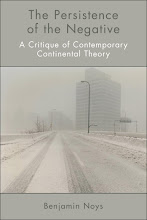
Benjamin Noys, The Persistence of the Negative: A Critique of Contemporary Continental Theory


Book launch and discussion
Chaired by Alberto Toscano, with responses by Jodi Dean and John Roberts
Friday 10 December 2010
5-7pm
Ben Pimlott Lecture Theatre
Goldsmiths, University of London
New Cross, Lewisham SE14 6NW

Today negativity is reified into images of disaster, apocalypse, terror, and depression, while contemporary theory insists on beginning from affirmation as the only way to resist the supposed 'failures' of negativity. The Persistence of the Negative (Edinburgh University Press, 2010) challenges this consensus and aims to rehabilitate a contemporary thinking of negativity as site of resistance. Analysing the 'affirmationist consensus', from Derrida to Badiou, via Deleuze, Latour, and Negri, The Persistence of the Negative excavates disavowed traces of negativity in their work, and relocates theory within the context of capitalist abstraction and crisis. This discussion deals with the core arguments of the book, placing the author in debate with leading theorists.


Benjamin Noys is Reader in English at the University of Chichester, and the author of Georges Bataille: A Critical Introduction and The Culture of Death, and the editor of the forthcoming Communization and its Discontents.


John Roberts is Professor of Art & Aesthetics at the University of Wolverhampton. He is the author of a number of books, including The Art of Interruption: Realism, Photography and the Everyday (Manchester University Press, 1998), and The Intangibilities of Form: Skill and Deskilling in Art After the Readymade (Verso, 2007).


Jodi Dean is Professor of Political Science at Hobart and William Smith Colleges and Erasmus Professor of the Humanities in the Faculty of Philosophy at Erasmus University in Rotterdam. She is the author, most recently, of Žižek’s Politics, Democracy and Other Neoliberal Fantasies and Blog Theory.


Alberto Toscano is Senior Lecturer in Sociology at Goldsmiths, and the author of Fanaticism: On the Uses of an Idea.


Monday, 25 October 2010

Book Launch II


Speaking at Sussex on my book for the seminar Studies on Social and Political Thought, on 3 November - details here.

Monday, 4 October 2010

Persistence of the Negative Book Launch I

A book launch will be held for my new book The Persistence of the Negative: A Critique of Contemporary Continental Theory (Edinburgh University Press, 2010) at The University of Chichester, Bishop Otter Campus, in Cloisters, 4pm to 5.15pm on Thursday 14 October - details also on facebook here.

It will be an informal event, with all welcome, however there will be a more 'academic' launch in London in late November as well.

Thursday, 26 August 2010

Accelerationism Event

But which is the revolutionary path? Is there one? – To withdraw from the world market, as Samir Amin advises Third World Countries to do, in a curious revival of the fascist "economic solution"? Or might it be to go in the opposite direction? To go further still, that is, in the movement of the market, of decoding and deterritorialization? For perhaps the flows are not yet deterritorialized enough, not decoded enough, from the viewpoint of a theory and practice of a highly schizophrenic character. Not to withdraw from the process, but to go further, to "accelerate the process," as Nietzsche put it: in this matter, the truth is that we haven't seen anything yet
– Gilles Deleuze and Felix Guattari, Anti-Oedipus

The English unemployed did not have to become workers to survive, they – hang on tight and spit on me – enjoyed the hysterical, masochistic, whatever exhaustion it was of hanging on in the mines, in the foundries, in the factories, in hell, they enjoyed it, enjoyed the mad destruction of their organic body which was indeed imposed upon them, they enjoyed the decomposition of their personal identity, the identity that the peasant tradition had constructed for them, enjoyed the dissolutions of their families and villages, and enjoyed the new monstrous anonymity of the suburbs and the pubs in morning and evening.
– Jean-Francois Lyotard Libidinal Economy

Machinic revolution must therefore go in the opposite direction to socialistic regulation; pressing towards ever more uninhibited marketization of the pro­cesses that are tearing down the social field, “still further” with “the movement of the market, of decoding and deterritorialization” and “one can never go far enough in the direction of deterritori­alization: you haven’t seen anything yet”.
– Nick Land, “Machinic Desire”

In the early 1970s, post-68 French thinkers such as Deleuze and Guattari and Lyotard made the heretical suggestion that capital should not be resisted but accelerated. Deplored, repudiated then forgotten, this remarkable moment was returned to only in the UK during the 1990s, in the theory-fiction of Nick Land, Iain Hamilton Grant, Sadie Plant and the Cybernetic Culture Research Unit. Drawing upon Fernand Braudel, Manuel DeLanda, and cyber-theory, 90s accelerationism drew a distinction between markets (as bottom-up self-organising networks) and capital (an oligarchic and predatory system of control). Was accelerationism merely a new cybernetic mask for neoliberalism? Or does the call to “accelerate the process” mark out a political position that has never been properly developed, and which still has a potential to reinvigorate the left?

This one-day symposium will think through the implications of accelerationism in the light of the forthcoming publication of Nick Land’s Fanged Noumena: Collected Writings 1987-2007 and Benjamin Noys’s The Persistence of the Negative.
Speakers:
Ray Brassier – co-editor with Robin Mackay of Nick Land's Fanged Noumena: Collected Writings 1987-2007 (2010)

Mark Fisher – author of k-punk blog and a founder member of the Cybernetic Culture Research Unit

Robin Mackay – philosopher, director of Urbanomic, editor of Collapse

Benjamin Noys – author of The Persistence of the Negative (2010), blogs at No Useless Leniency

Nick Srnicek – author of Speculative Heresy blog, PhD candidate at LSE, and is working with Alex Williams on a book critiquing folk politics

Alex Williams – working on a book on accelerationism, blogs at Splintering Bone Ashes
Room RHB 256

Friday, 20 August 2010

Urbanomic at the Tate

URBANOMIC PRESENTS ‘LATE AT TATE BRITAIN’:
THE REAL THING: SPECULATIVE REALISM IN CONTEMPORARY ART

Amanda Beech Sanity Assassin (2010)
John Gerrard Lufkin (near Hugo, Colorado) (2009)
Mikko Canini The Black Sun Rise (2010)
Pamela Rosenkranz Bow Human (2009)

On 3rd September 2010, Urbanomic present Late at Tate: The Real Thing, an evening event at Tate Britain with contemporary sound, video and sculptural work, and other interventions exploring the emerging philosophical paradigm of Speculative Realism and its impact on contemporary art practice.

Featuring work by artists Amanda Beech, William Bennett, Mikko Canini, John Gerrard, Florian Hecker and Pamela Rosenkranz, the event will include:

Premieres of two new sound works commissioned by Urbanomic:

Speculative Solution by Florian Hecker, exploring conceptual themes from French philosopher Quentin Meillassoux's After Finitude, which argues for the absolute contingency of all laws of nature;

Extralinguistic Sequencing by William Bennett (Whitehouse) + Mimsy DeBlois, using processed voice recordings and disorienting language patterns to expose an extralinguistic reality operating beneath ‘meaning’.

Screenings of British artist Amanda Beech's Sanity Assassin (2009), a claustrophobic journey through exiled German philosopher Adorno's LA nightmares, and drawing on philosopher Ray Brassier's nihilist masterpiece Nihil Unbound, with its declaration that we are all ‘already dead’; and Canadian artist Mikko Canini’s The Black Sun Rise (2010), a darkly abstract survey of a depopulated London.

An invasion of one of the Tate’s sculpture galleries by work drawn from Swiss artist Pamela Rosenkranz's 2009 Venice Biennale show Our Sun. A speculative-realist interrogation of the classic Venetian aesthetic of ‘light and water’, Rosenkranz’s work opens a dialogue with Reza Negarestani's Cyclonopedia, a ‘theory-fiction’ that rethinks the relation between sun and earth.
A curatorial intervention rethinking the Tate Britain room Art and the Sublime as The Real and the Sublime, with a work by Irish artist John Gerrard, who uses advanced 3d technology to create uncannily ‘real’ virtual environments.

A panel discussion with Amanda Beech, Mikko Canini, Mark Fisher (K-Punk), Iain Hamilton Grant, Robin Mackay, and Pamela Rosenkranz.

Centred around the approaches of philosophers Quentin Meillassoux (Paris), Ray Brassier (American University in Beirut), Iain Hamilton Grant (Bristol UWE) and Graham Harman (American University in Cairo), and with the additional tangential influence of Iranian philosopher Reza Negarestani, Speculative Realism refuses to interrogate reality through human (linguistic, cultural or political) mediations of it, instead drawing upon objective discourses such as mathematics, geology, astrophysics and chemistry to explore the possibility of conceiving of a reality indifferent to humans – a universe that exists before, after, and despite its manifestation in human experience.

As well as generating tremendous interest in philosophical circles, Speculative Realism has also been taken up in cultural theory and contemporary art, suggesting that the paradigm of a human-indifferent universe strikes a chord with twenty-first century cultural preoccupations. Urbanomic’s journal Collapse was instrumental in bringing Speculative Realism to public attention, having published in 2007 (in Collapse III) the proceedings of the group’s inaugural conference at Goldsmiths, University of London, and having consistently featured original work by the members of the group.

Programme
Sackler Octagon
1800-1900 and 1930-2100 William Bennett + Mimsy De Blois Extralinguistic Sequencing
1900 and 2100 Florian Hecker Speculative Solution
Clore Auditorium
1800-1930 and 2100-2200 Amanda Beech Sanity Assassin (25 min., timed screenings)
1945 - 2045 Panel Discussion: The Real, Representation, and the In-Itself.
Manton Studio
Mikko Canini The Black Sun Rise (3.54., continuous screening)
Ongoing Interventions
Room 9
Urbanomic The Real and the Sublime
John Gerrard Lufkin (near Hugo, Colorado)
Room 13
Pamela Rosenkranz Our Sun
Pamela Rosenkranz’s work courtesy of Karma International, Zurich.
John Gerrard’s work courtesy of Thomas Dane, London.
Hecker commission supported by The Elephant Trust.
More information: Mahogany deWitt: +44 (0) 7854309897

Thursday, 1 July 2010

Fanaticism Event


FANATICISM

On the Uses of an Idea

By Alberto Toscano

Alberto Toscano will be launching ‘Fanaticism’ on Thursday 8 July, 6.45pm, at the Institute of Contemporary Arts, The Mall, London SW1Y 5AH. Toscano will address the key issues at the heart of his new book, and welcome discussion from attendees. For more information and to book tickets, please call +44 (0)20 7930 3647, or visit the ICA website.

About the book:
The idea of fanaticism as a deviant or extreme variant of an already irrational set of religious beliefs is today invoked by the West in order to demonize and psychologize any non-liberal politics. Alberto Toscano’s compelling and erudite counter-history explodes this accepted interpretation in exploring the critical role fanaticism played in forming modern politics and the liberal state. Tracing its development from the traumatic Peasants’ War of early sixteenth-century Germany, to contemporary Islamism, Toscano tears apart the sterile opposition of ‘reasonableness’ and fanaticism. Instead, in a radical new interpretation, he places the fanatic at the very heart of politics, arguing that historical and revolutionary transformations require a new understanding of its role. Showing how fanaticism results from the failure to formulate an adequate emancipatory politics, this illuminating history sheds new light on an idea that continues to dominate debates about faith and secularism.

About the author:
Alberto Toscano is a senior lecturer in sociology at Goldsmiths, University of London. He is the author of The Theatre of Production, translator of Alain Badiou’s The Century and Logics of Worlds and co-editor of Alain Badiou’s Theoretical Writings and On Beckett. He has published numerous articles on contemporary philosophy, politics and social theory, and is an editor of Historical Materialism. More information can be found here.

Wednesday, 26 May 2010

Abstraction, Universality and Money

7th annual conference of the Marx and Philosophy Society

Abstraction, Universality and Money

Institute of Education, University of London 20 Bedford Way, London
Saturday 5 June 2010, 9.30-6.00
Conference poster [pdf]
Abstracts

Plenary speakers:
Richard Seaford (Exeter)Money, Abstraction, and the Genesis of the Psyche

Alberto Toscano (Goldsmiths) 'The Dead Pledge of Society: Methodological Problems and Political Consequences of 'Real Abstraction'

Christopher ArthurAbstraction, Universality and Money
Martin Sohn-RethelMemories of my Father, Alfred Sohn-Rethel

Graduate panels:
(1)Jan Sailer (Freiburg)Securities: The Purest Form of Abstract Wealth. A Re-evaluation of the Concept of 'Fictitious Capital'

Nick Gray (Sussex)Abstraction, Universality, Money and Capital: The Capital-Theory of Value

Marina Vishmidt (Queen Mary, University of London) Art in and as Abstract Labour

(2)Brian Fuller (York University, Toronto) Materialism and Dialectic: Reading Marx after Adorno

Tim Carter (Sussex) Alienation and Domination in Marx and Wittgenstein's Philosophical Anthropologies

Chris Allsobrook (Sussex)Meta-Maieusis: The Ideological Normative Grounds of Immanent Critique

£15 waged, £10 unwaged (provides annual membership of the Society).
To reserve a place in advance please email David Marjoribanks.
Directions: http://www.ioe.ac.uk/sitehelp/1072.htm

Thursday, 6 May 2010

TRG Seminar next week


Theory Research Group presents

David Cunningham
[University of Westminster]

‘Capitalist and Bourgeois Epics:
Lukács and the Theory of the Novel’


Tuesday 11 May 1-3pm Cloisters, The University of Chichester, Bishop Otter Campus, College Lane, Chichester

Friday, 26 March 2010

Activist Realism Event

ACTIVIST REALISM

SATURDAY, 10TH APRIL 2010, 6-9PM

LARC @ 62 FIELDGATE STR, WHITECHAPEL, LONDON

Monday, 22 March 2010

Fanaticism

The Theory Research Group is proud to welcome Alberto Toscano, presenting on 'Fanaticism', 1-3pm, The University of Chichester, March 30 2010. For further details please contact Benjamin Noys, all welcome.


Monday, 15 March 2010

Cartographies of the Absolute


CADRE Lecture Series
Free Public Lecture by
Dr. Alberto Toscano (Goldsmiths, University of London)Tuesday 23rd March 2010, 6.00pm, MK045

Postgraduate, Research and Enterprise Administrative Assistant MK505 I School of Art & Design Molineux Street Wolverhampton WV1 1DT


Cartographies of the Absolute, abstract and image


Revisiting the challenge posed by Fredric Jameson in his 1989 article on 'cognitive mapping', this presentation will consider the recent surge in attempts, across popular entertainment and contemporary art, to provide models, diagrams or narratives that might allow us to orient ourselves around the world system. From the multi-dimensional narrative exploration of the political economy of urban dispossession in The Wire to 'commodity-chain' films like Lord of War, from Mark Lombardi's diagrams of institutional collusion to Allan Sekula's Fish Story, the desire for an aesthetic that would provide knowledge of the totality seems widespread.

Saturday, 13 March 2010

Schizoanalysis and Visual Culture

Centre for Critical and Cultural Theory
Venue: Cardiff University, Cardiff, UK, June 1st /2nd

What is schizoanalysis and how might it be applied to the analysis of contemporary visual culture? This question is both daunting in its complexity and exciting in terms of the possibility for a whole new way of thinking about visual culture it offers. Answering it seems to require that we experiment with Deleuze and Guattari’s ideas and concepts to produce our own new syntheses adequate to the demands of the present creative, historical and theoretical conjuncture we find ourselves in today. That is the challenge this symposium will take up by bringing together some of the most creative and exacting scholars working in the twin fields of Deleuze studies and film studies today.