Monday, 20 December 2010

Hostile Objects

Theory Research Group Presents
'Hostile Objects'
Evan Calder Williams (Santa Cruz)

Thursday 20th January 2011
5-7pm
University of Chichester, Bishop Otter Campus


Sunday, 28 November 2010

Two Goldsmiths events December 10

Jodi Dean, Blog Theory (book launch and discussion), Chair: Matthew Fuller, Respondents: Nina Power, Owen Hatherley
2-4pm, NAB LG01


Benjamin Noys, The Persistence of the Negative: A Critique of Contemporary Continental Theory


Book launch and discussion
Chaired by Alberto Toscano, with responses by Jodi Dean and John Roberts
Friday 10 December 2010
5-7pm
Ben Pimlott Lecture Theatre
Goldsmiths, University of London
New Cross, Lewisham SE14 6NW

Today negativity is reified into images of disaster, apocalypse, terror, and depression, while contemporary theory insists on beginning from affirmation as the only way to resist the supposed 'failures' of negativity. The Persistence of the Negative (Edinburgh University Press, 2010) challenges this consensus and aims to rehabilitate a contemporary thinking of negativity as site of resistance. Analysing the 'affirmationist consensus', from Derrida to Badiou, via Deleuze, Latour, and Negri, The Persistence of the Negative excavates disavowed traces of negativity in their work, and relocates theory within the context of capitalist abstraction and crisis. This discussion deals with the core arguments of the book, placing the author in debate with leading theorists.


Benjamin Noys is Reader in English at the University of Chichester, and the author of Georges Bataille: A Critical Introduction and The Culture of Death, and the editor of the forthcoming Communization and its Discontents.


John Roberts is Professor of Art & Aesthetics at the University of Wolverhampton. He is the author of a number of books, including The Art of Interruption: Realism, Photography and the Everyday (Manchester University Press, 1998), and The Intangibilities of Form: Skill and Deskilling in Art After the Readymade (Verso, 2007).


Jodi Dean is Professor of Political Science at Hobart and William Smith Colleges and Erasmus Professor of the Humanities in the Faculty of Philosophy at Erasmus University in Rotterdam. She is the author, most recently, of Žižek’s Politics, Democracy and Other Neoliberal Fantasies and Blog Theory.


Alberto Toscano is Senior Lecturer in Sociology at Goldsmiths, and the author of Fanaticism: On the Uses of an Idea.


Monday, 22 November 2010

Formalism and the Subject 29-30 November 2010


Formalism and the Subject (Form and Formalism II)
November 29-30, 2010
Jan Van Eyck Academie
Maastricht, Netherlands

Organized by: Pietro Bianchi and Tzuchien Tho

Please see our website for abstracts and updates


‘The object of science is no longer only the specific domain of problems — of obstacles to resolve — it is also the intention and the aim of the subject of science. That is to say, it is the specific project that constitutes a theoretical conscience as such.”
--What is psychology? Georges Canguilhem, 1958


A contemporary positivist doxa situates a partition between science and philosophy where the former would constitute the domain of formal models based on the foreclosure of the subject and the latter would address the critical stance from the point of view of the empirical experience. This situation counterposes a mutually exclusive relation between a domain of consciousness and its correlative object of cognition: between a critical stance legitimated under the name of veracity and the domain of a-historical and a-subjective formal theorization. In this positivist psychologization of the “subject” of science, we are faced with two dead ends. Either we accept the merely “critical” standpoint of a philosophical subject that remains outside and, as the philosophers would have it, above, science, or we reduce subjectivity itself to the internal circulation of the object-subject relation that satisfies the normalized standards of correlative veracity.


This counter-position constitutes a fundamental obstacle for the contemporary approaches to rethink and re-problematize the nature of so-called “objective” knowledge. The place of the subject is an “in-between” which seems to be reluctant to every form of reduction, representation, formalization. Constantly doomed to the oscillation between the enunciated and enunciation, between what is said and the very event of saying, between the signifiers and the letter, between the speaking body and the grammatical subject. Is the subject simply a voided place-holder with no substantiality? The pure movement of the impossible rapport between the two?


Investigation by means of the issue of formalism intervenes here as an alternative. As one of the very means by which this separation between the subject (or mind, consciousness, etc.) and object (or world, reality, etc.) is made, the investigation of formalism itself is an opportunity to tear the subject away from its merely critical or, alternatively, empirical determinations. In other words, if formalism is the means by which a consciousness represents to itself the nature of the external reality, then the interrogation of this space of formalization itself is none other than the reckoning with the very nature of this counter-position between the subjective and objective. If so, then the transformation of the formal dimension is also the transformation of this rapport: the reconstitution of the subject, its representations and its localization in the field of knowledge and discourse. This dynamical movement, between formalization and (re)localization, is no doubt reorganized and renormalized into a constituted scientific body of knowledge in due course. Yet, in this narrow gap of indetermination, a vision of a “subject”, caught between empirical consciousness and its objective constitution, opens into a possible nomination that may allow us to seize a conception of a “subject” which points to an excess “in-between” which seems to resist determination.


The aim of the workshop is to try to address the avenues afforded for rethinking the problem of the subject by the investigation of formalism itself. Working in the context of the paths opened by the French epistemologie tradition, psychoanalysis and the recent wave of French anti-phenomenological philosophies of Deleuze and Badiou, we hope to explore the new frontiers that lie on the horizon as recent innovations in the formal sciences (formal logic and mathematics) have not only granted us new means to interrogate the domain of subjectivity but also allow us to transform its very topos. This will also be an opportunity to reevaluate the status of psychoanalysis' use of formal structures (matheme, knots and topology) in light of recent developments in these fields.

Schedule:
29/11/2010 Monday

14h – 14h30
Formalism and the subject: elements toward a problematic
Welcome and introduction by Pietro Bianchi and Tzuchien Tho

14h30-16h30
Form and Logical Structure in Badiou's Logiques des mondes
Beau Madison Mount
Response by Tzuchien Tho

16h30-18h30
Formalism and the Subject: Reflections on the Origin of Gauge Theory
Silvia de Bianchi
Response by Tzuchien Tho

19h
Conference Dinner

30/11/2010 Tuesday

11h-13h
Formalisation and situation: Some elements for a materialistic reading of Lacan’s “four discourses”
Livio Boni
Response by Tom Eyers

14h-16h
Topological forms and their descriptive logic —the implications for thinking the subject in Deleuze’s The Fold, Leibniz and the Baroque
Niamh McDonnell
Response by Pietro Bianchi

16h-18h
Consistence/Inconsistence: Disruptions in the Isotopy of a Borromean
Benjamin Bishop
Response by Carlos Guillermo Gómez Camarena

19h
Roundtable discussion
++++++++++++++++++++++++++++++++

Monday, 8 November 2010

crisis and critique


Last chance to book online.

Monday, 25 October 2010

Book Launch II


Speaking at Sussex on my book for the seminar Studies on Social and Political Thought, on 3 November - details here.

'Crisis and Critique' 7th Annual HM Conference, London

'Crisis and Critique': Historical Materialism Annual London Conference
2010,

Central London, Thursday 11th to Sunday 14th November*

Registration and Provisional Programme Now Available
online:

ALL ATTENDEES AND SPEAKERS MUST PRE-REGISTER, PRE-REGISTRATION CLOSES
AT MIDNIGHT ON NOVEMBER 8TH


Notwithstanding repeated invocations of the ‘green shoots of recovery’, the effects of the economic crisis that began in 2008 continue to be felt around the world. While some central tenets of the neoliberal project have been called into question, bank bailouts, cuts to public services and attacks on working people's lives demonstrate that the ruling order remains capable of imposing its agenda. Many significant Marxist analyses have already been produced of the origins, forms and prospects of the crisis, and we look forward to furthering these debates at HM London 2010. We also aim to encourage dialogue between the critique of political economy and other modes of criticism – ideological, political, aesthetic, philosophical – central to the Marxist tradition.

In the 1930s, Walter Benjamin and Bertolt Brecht projected a journal to be called ‘Crisis and Critique’. In very different times, but in a similar spirit, HM London 2010 aims to serve as a forum for dialogue, interaction and debate between different strands of critical-Marxist theory. Whether their focus is the study of the capitalist mode of production's theoretical and practical foundations, the unmasking of its ideological forms of legitimation or its political negation, we are convinced that a renewed and politically effective Marxism will need to rely on all the resources of critique in the years ahead. Crises produce periods of ideological and political uncertainty. They are moments that put into question established cognitive and disciplinary compartmentalisations, and require a recomposition at the level of both theory and practice. HM London 2010 hopes to contribute to a broader dialogue on the Left aimed at such a recomposition, one of whose prerequisites remains the young Marx’s call for the ‘ruthless criticism of all that exists’.

Themes discussed by the Conference include: Activism * Adorno: Philosophy, Aesthetics, Politics * Aesthetics of Crisis * Art and Activism * Althusser and the Aleatory Encounter I: Conceptual Aspects * Althusser and the Aleatory Encounter II: Philosophical Contrasts * Applying Value Theory * Approaching Passive Revolutions * Art in Neoliberalism * The Arts and Capitalist Triumphant: American Culture in the 1940s * Between Political Economy and Political Struggles * Beyond What Is and Isn’t to Be Done: The Question of Organisation Today * Biocapitalism * Bolshevik History * Book Launch: Jairus Banaji's Theory as History * Capital and the Crisis of Nature * Capitalism, Labour, Photography * Centenary of Hilferding’s Finance Capital * China: Internal Struggles and External Perceptions * Class, Gender, Crisis: The Attack on Public Services and Welfare * Class and Nation in the Middle East * Climate Change and Ecological Crisis: Law, Gender, Technology * Commodities, Labour and Space * Conjuncture, Contingency and Overdetermination * The Contemporary Global Economy (Marx and the ‘Global South’ 1) * Crisis and Accumulation in Asia * Crisis of Representation: Philosophy, Politics, Aesthetics * Crisis in Greece, Crisis in the Eurozone * The Crisis this Time * Commons and Commonwealths * Commons and Communism, Past and Present * Confronting the Right * Cultural Contradictions of Capitalism * Death and Utopia: Bloch and Benjamin * Dependency and Exploitation in Latin America * Dimensions of the Crisis: History, Finance, and the Labour Process * Energy and Crisis * The End of Old and New Labour: What's Left?* Eurozone Crisis: Causes and Ways Out * Feminism and the Critique of Political Economy * Financial Capital Before and After the Crisis * Financialisation: Theory and Practice * Forgotten Space: Capitalism and the Sea * Forms of Working-Class Resistance * From Crisis To Crises: Marxist Perspectives On Latin America In The Global Economy * From Crisis of Capitalism to Crisis of the Public Sector * Gender, Labour and the Future of Feminism * Geographies of Crisis and Critique I * Geographies of Crisis and Critique II * German Crises * Georg Lukács and the Aspiration Towards Totality * Gramsci * Historical Materialism, Universal History, and East Asia * Histories of Workers’ Struggles * The Ideology of the ‘Big Society’ * Imperialism: History and Theory * Intellectuals, Public Discourse and Education * International Relations, Militarism and Modes of Foreign Relations * Japanese and Western Marxism * Korsch, Lefebvre and Hegelian Marxism * Labour and Migration * Labour Power and the Marxian Analytics of Crisis * Latin America, Resistance and Political Economy * Legacies of Bolshevism * Lenin, Luxemburg and the Russian Revolution * Limits of Citizenship and Democracy * Managing Crisis: Fair Trade, Cooperatives, Degrowth * Marx Against Eurocentrism (Marx and the ‘Global South’ 2) * Marx and Critique * Marxian Investigations * Marxism and Geopolitics * Marxism and International Law * Marxism and Politics Today * Marxism and Theories of Politics * Marxist Theories of Finance and Risk * Marxist Theory and Cultural Politics * Marx for Our Times * Marx, Normativity, Justice * Marx’s Capital and the Development of Capitalism Today * Music and Resistance * Neoliberalism and World Cinema: A Double Take * Palestine and Global Justice: Current and Historic Challenges for the Left * Poetics, Painting, Politics * Political Ecology in a Time of Crisis * Political Economy and Value Theory * The Politics and Political Economy of the Media * The Politics of Housing * Profit and the Crisis * Radicalism in Contemporary Art and Literature * Red October: Left-Indigenous Struggles in Modern Bolivia * Rethinking the State * Rosa Luxemburg and the Critique of Political Economy * Screening: Comuna Under Construction * Servicing the Crisis * Sex in Crisis * Slavery and American Capitalism * Stasis, Contradiction, Hostility * Strategies for Art Today I * Strategies for Art Today II * Theorising the Crisis I * Theorising the Crisis II * Theorising the Crisis III * The Transformation of Chinese Marxism * Ultra-Leftism, Insurrection, and the City * Useless But True: Economic Crisis and the Peculiarities of Economic Science * Value and Struggles in China * Varieties of Capitalism I * Varieties of Capitalism II * Violence and Non-Violence * Walter Benjamin and Anthropological Materialism * Walter Benjamin and the Critique of Violence * Whither Feminism? * Who Rules the World? Contemporary Views on Ruling and Capitalist Classes * Workers, the Union Movement and the Crisis * Workers’ Self-Management and Alternative Work Organisation I * Workers’ Self-Management and Alternative Work Organization II * The Working Class after Neoliberalism: From the World to the East End of Glasgow * The Work of Daniel Bensaid *


Speakers include: Greg Albo * Bueno Aldo * Görkem Akgöz * Idris Akkuzu * Donatella Alessandrini * Anne Alexander * Jamie Allinson * Elmar Altvater * Marko Ampuja * James Anderson * Kevin Anderson * Alex Anievas * Caroline Arscott * Sam Ashman * John Ashworth * Tara Atluri * Maurizio Atzeni * Antonio Azevedo * Dario Azzellini * Abigail Bakan * Jeff Bale * Jairus Banaji * Laurent Baronian * Luca Basso * Amita Baviskar * Wesley Baxter * Dave Beech * Riccardo Bellofiore * Aaron Benanav * Marc Berdet * Janis Berzins * Beverley Best * Brenna Bhandar * Alain Bihr * Cyrus Bina * Robin Blackburn * Paul Blackledge * Joost de Bloois * Iain Boal * Roland Boer * Armando Boito * Patrick Bond * Bill Bowring * Chris Boyd * Umut Bozkurt * Honor Brabazon * Craig Brandist * Pepijn Brandon * Lutz Brangsch * Colm Breathnach * Peter
Brogan * Heather Brown * Sebastian Budgen * Jonah Butovsky * Alex Callinicos * Liam Campling * Bob Cannon * Thomas Carmichael * The Carrot Workers Collective * Warren Carter * Noel Castree * Aude de Caunes * Maria Elisa Cevasco * Giorgio Cesarale * Sharad Chari * Matthew Charles * François Chesnais * Danielle Child * ChristopherbChitty * Joseph Choonara * John Clegg * Perci Coelho * Sheila Cohen * Alejandro Colás * Nathan Coombs * John Cooper * Luke Cooper * Gareth Dale * Neil Davidson * Chuck Davis * Tim Dayton * Shane Deckard * Radhika Desai * Li Dianlai * Katja Diefenbach * Angela Dimitrakaki * James Dunkerley * Bill Dunn * Cedric Durand * Nick Dyer-Witheford * Caroline Edwards * Steve Edwards * Evie Embrechts * Katsuhiko Endo * Theresa Enright * Adam Fabry * Mauro Farnesi Camellone * Sara Farris * David Featherstone * Romain Felli * Oliver Feltham * David Fernbach * Michele Filippini * Ben Fine * Eoin Flaherty * Paul Flenley * Keith Flett * Kirsten Forkert * Des Freedman * Alan Freeman * James Furner * Nicola Fusaro * Jin Gao * Lindsey German * M.A. Gonzalez * Sara Gonzalez * James Goodman * Jamie Gough * Nicolas Grinberg * Agon Hamza * Adam Hanieh * Bue Rübner Hansen * Jane Hardy * Lea Haro * Barnaby Harran * Barbara Harriss-White * Johan Hartle * Dan Hartley * Mike Haynes * Amrit Heer * Paul Heideman * Christoph Hermann * Chris Hesketh * Andy Higginbottom * Jan Hoff * John Holloway * Charlie Hore * Nik Howard * Peter Hudis * Ian Hussey * Michel Husson * Ursula Huws * Anthony Iles * Ozlem Ingun * Robert Jackson * Dhruv Jain * Sang-Hwan Jang * Anselm Jappe * Olivier Jelinski * Heesang Jeon * Seongjin Jeong * Jonny Jones * Jyotsna Kapur * Rémy Herrera * Marina Kaneti * Ioannis Kaplanis * Elif Karacimen * Rebecca Karl * Ken Kawashima * Alexander Keller Hirsch * Mark Kelly * Anneleen Kenis * Paul Kellogg * Christiane Ketteler * Sami Khatib * Jim Kincaid * Don Kingsbury * Stathis Kouvelakis * Sam Knafo * Juha Koivisto * Stathis Kouvelakis * Michael R. Krätke * Clarice Kuhling * Alexi Kukuljevic * Anne E. Lacsamana * Mikko Lahtinen * Ishay Landa * Costas Lapavitsas * Amanda Latimer * Nick Lawrence * Philippe Lege * Emanuele Leonardi * Esther Leslie * Alex Levant * Les Levidow * Iren Levina * Norman Levine * Ben Lewis * Aiyun Liang * Lars Lih * Jacob Carlos Lima * Por-Yee Lin * Duncan Lindo * Nicola Livingstone * Alex Loftus * Domenico Losurdo * Nikos Lountos * David Mabb * Denis Mäder * Yahya Madra * F.T.C. Manning * Paula Marcelino * Fábio Marvulle * Pierre Matari * Paul Mattick * Patricia McCafferty * Daniel McCarthy * Andrew McGettigan * David McNally * James Meadway * Eileen Meehan * Antigoni Memou * Zhang Meng * David Michalski * China Miéville * Owen Miller * Seamus Milne * Andrew Milner * Dimitris Milonakis * Gautam Mody * Simon Mohun * Kim Moody * Colin Mooers * Michael Moran * Vittorio Morfino * Adam David Morton * Avigail Moss * Sara Motta * Tadzio Mueller * Sara Murawski * Douglas Murphy * Mary Jo Nadeau * Yutaka Nagahara * Immanuel Ness * Susan Newman * Michael Niblett * Stephen Norrie * Benjamin Noys * Sebnem Oguz * Francisco Ojeda * Chris O’Kane * Kosuke Oki * Ken Olende * Ozlem Onaran * Ahmet Öncü * Ozgur Orhangazi * Judith Orr * Reecia Orzeck * Ceren Ozselcuk * Leo Panitch * Giorgos Papafragkou * Rose Parfitt * Mark Paschal * Jody Patterson * Laurie Penny * He Ping * Simon Pirani * Charles Post * Nina Power * Gonzalo Pozo-Martin * Lucia Pradella * Tim Pringle * Toni Prug * Muriel Pucci * Besnik Pula * Thomas Purcell * Sam Putinja * Uri Ram * Gene Ray * Jason Read * John Rees * Oliver Ressler * Felicita Reuschling * Larry Reynolds * John Roberts * John Michael Roberts * William Roberts * Ed Rooksby * Sadi dal Rosso * Christina Rousseau * Devi Sacchetto * Giorgos Sagriotis * Spyros Sakellaropoulos * Gregory Schwartz * David Schwartzman * Ian J. Seda-Irizarry * Allan Sekula * Ben Selwyn * Richard Seymour * Greg Sharzer * Greg Shollette * Jan Sieber * Mark Silverman * Oishik Sircar * Murray E.G. Smith * Jason Smith * John Smith * Jeffrey Sommers * Panagiotis Sotiris * Michalis Spourdalakis * Kerstin Stakemeier * Julian Stallabrass * Guido Starosta * Engelbert Stockhammer * Robert Stolz * Ted Stolze * Kendra Strauss * Bronislaw Szerszynski * Jeff Tan * Keeanga-Yamahtta Taylor * Kampagiannis Thanassis * Tzuchien Tho * Martin Thomas * Peter Thomas * Peter Thompson * Hillel Herschel Ticktin * Vladimir Tikhonov * Oxana Timofeeva * Bruno Tinel * Tania Toffanin * Massimiliano Tomba * Stavros Tombazos * George Tomlinson * Samo Tomsic * Jan Toporowski * Alberto Toscano * Nicos Trimikliniotis * Ben Trott * Pei Kuei Tsai * Alan Tuckman * Deborah Tudor * Lori Turner * Alexej Ulbricht * Steve Vallance * Giovanna Vertova * Marina Vishmidt * Keith Wagner * Hilary Wainwright * Gavin Walker * Andrew Warstat * Ben Watson * Michael Watts * Mike Wayne * Alexis Wearmouth * Jeffery R. Webber * John Weeks * Brian Whitener * Evan Calder Williams * Frieder Otto Wolf * Xinwang Wu * Wu Xinwei * Galip Yalman * Faruk Yalvaç * Eddie Yuen * Rafeef Ziadah * Mislav Zitko *

Monday, 4 October 2010

Persistence of the Negative Book Launch I

A book launch will be held for my new book The Persistence of the Negative: A Critique of Contemporary Continental Theory (Edinburgh University Press, 2010) at The University of Chichester, Bishop Otter Campus, in Cloisters, 4pm to 5.15pm on Thursday 14 October - details also on facebook here.

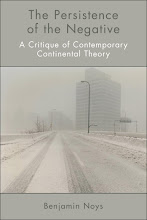
It will be an informal event, with all welcome, however there will be a more 'academic' launch in London in late November as well.